The coffee

100% Arabica

Arabica instant coffee is the only coffee printed on the Joe's Blend box, listed fourth of nine ingredients as 'Arabica instant coffee (Coffea arabica seed extract)'. That is what 100% Arabica means here: the label names one coffee species and no Robusta.

Ingredient 4 of 9Coffea arabica onlyInstant coffee extract

Source for this section: the printed Joe's Blend box, batches 140525JCA3 and 140525JCA7.

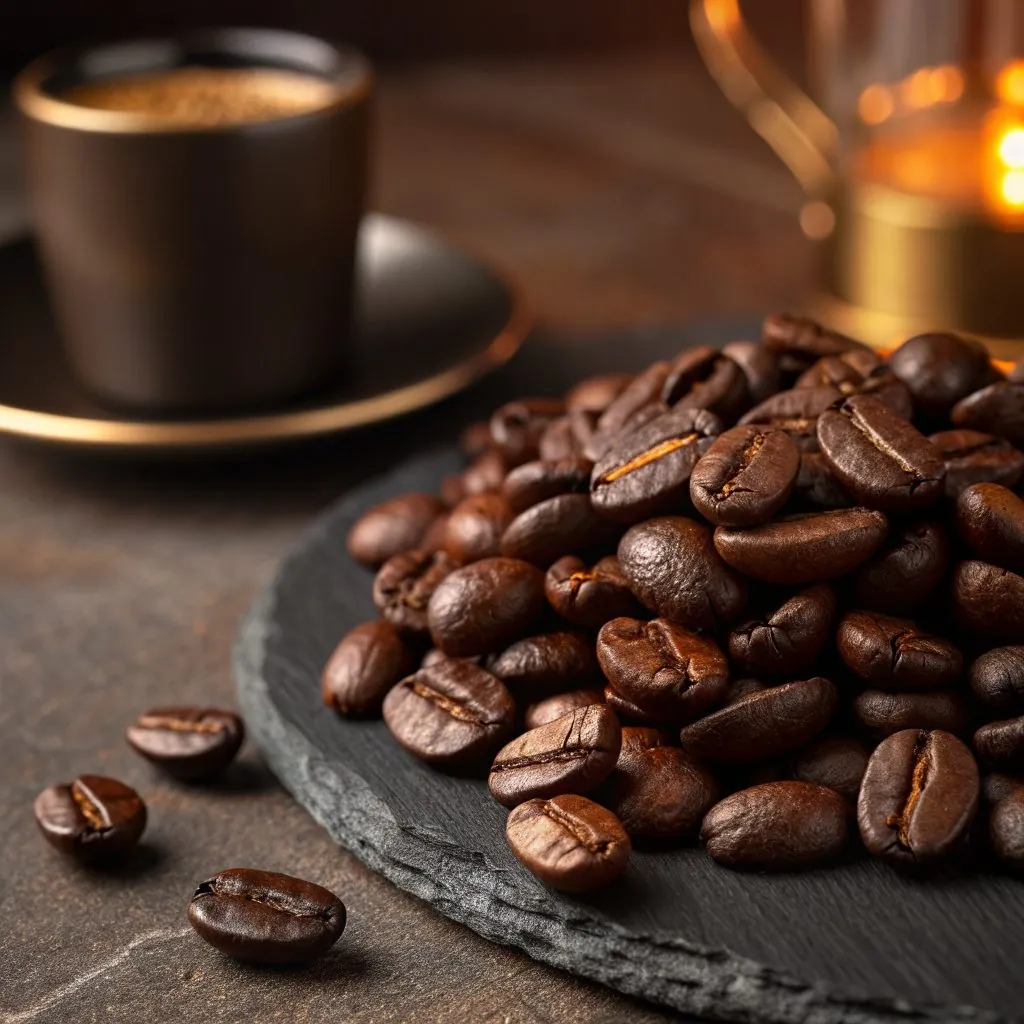
Roasted arabica beans on slateIn every 21 g sachet

What is arabica coffee?

Arabica is coffee from the plant Coffea arabica, one of the two main commercial coffees; the other is Coffea canephora, traded as Robusta. Coffee beans are seeds. Roasting changes their chemistry, and the drink made from roasted beans carries caffeine, trigonelline, chlorogenic acids, cafestol, kahweol and the aroma compounds formed in the roaster.

Instant coffee is coffee extract dried into a powder. Food scientists make it by extracting roasted beans and then freeze drying or spray drying the extract. That is why the Joe's Blend label says 'seed extract' rather than ground coffee: the powder dissolves because it is already brewed coffee, dried.

Sources for this section: Alonso-Salces and colleagues, Journal of agricultural and food chemistry, 2009, PMID 19298065; Ludwig and colleagues, Food & function, 2014, PMID 24671262; Corso and colleagues, Journal of food science and technology, 2016, PMID 27570262; Wongsa and colleagues, Food chemistry, 2019, PMID 30722914.

Arabica on the Joe's Blend box, at a glance

Printed as
Arabica instant coffee (Coffea arabica seed extract)
Position
4 of 9. Cane sugar, non-dairy creamer and vanilla flavor come before it.
Other coffee listed
None. No Robusta or Coffea canephora appears on the box.
Form
Instant coffee: a dried extract of roasted beans
Caffeine per sachet
Not measured yet. The Eurofins report covers nutrition only, and the box prints no caffeine figure.
How to make it
One sachet in 200 ml of hot or cold water, stirred well

Sources for this section: the printed Joe's Blend box, batches 140525JCA3 and 140525JCA7; Corso and colleagues, Journal of food science and technology, 2016, PMID 27570262; Eurofins nutrient report AR-25-E9-005753-01.

Why is coffee fourth on the label?

Packaged food labels list ingredients from the heaviest to the lightest at the time the food is made, and a mixed ingredient such as the creamer gets its own list in brackets. Read that way, the Joe's Blend box says a sachet holds more cane sugar, more non-dairy creamer and more vanilla flavor than instant coffee, and more coffee than soybean seed extract, L-carnitine, L-theanine, glutathione and the silicon dioxide added on its own, ninth on the list.

The label prints no gram figure for any single ingredient, so the order is the only clue to the proportions. We do not turn it into a percentage.

Sources for this section: Codex Alimentarius labelling standard CODEX STAN 1-1985, FAO and WHO; the printed Joe's Blend box, batches 140525JCA3 and 140525JCA7.

Arabica vs Robusta: what did the lab studies measure?

Researchers who analysed green beans from Brazil, Colombia, Ethiopia, Honduras, Kenya, Mexico, Peru, Uganda and Vietnam found Coffea canephora higher in caffeine than Coffea arabica in every comparison, with Kenyan Arabica standing out for low caffeine. The two species differ enough in caffeine and phenolic compounds that labs use those profiles to tell them apart.

What those studies cannot tell you is the caffeine in a Joe's Blend sachet. That depends on how much instant coffee goes into each 21 g, which the label does not print, so we have not put a number on it.

Sources for this section: Babova and colleagues, Phytochemistry, 2016, PMID 26837609; Alonso-Salces and colleagues, Journal of agricultural and food chemistry, 2009, PMID 19298065.

The research

What does the research on Arabica coffee cover?

Five papers sit behind this page. For each, we describe what it measured.

Chemical partitioning and antioxidant capacity of green coffee (Coffea arabica and Coffea canephora) of different geographical origin.

Babova O, Occhipinti A, Maffei ME. Phytochemistry, 2016.

Measured caffeine and chlorogenic acids in green Arabica and Canephora beans from nine countries. Canephora was higher in caffeine every time; Kenyan Arabica had low caffeine and high chlorogenic acids.

PubMed 26837609 →

Botanical and geographical characterization of green coffee (Coffea arabica and Coffea canephora): chemometric evaluation of phenolic and methylxanthine contents.

Alonso-Salces RM, Serra F, Reniero F. Journal of agricultural and food chemistry, 2009.

Analysed phenolic compounds and caffeine in green Arabica and Robusta from America, Africa, Asia and Oceania, and showed the profiles identify the species and, in part, the growing region.

PubMed 19298065 →

Development of an instant coffee enriched with chlorogenic acids.

Corso MP, Vignoli JA, Benassi Mde T. Journal of food science and technology, 2016.

Made instant coffees from freeze-dried extracts of medium and dark roasted Arabica and Canephora, measured caffeine and chlorogenic acids, and had 42 consumers rate colour, aroma, flavour and body.

PubMed 27570262 →

Quality and bioactive compounds of blends of Arabica and Robusta spray-dried coffee.

Wongsa P, Khampa N, Horadee S. Food chemistry, 2019.

Made spray-dried coffees from different ratios of roasted Robusta and green Arabica, then measured their chemistry, 42 volatile compounds and how much tasters liked each brew.

PubMed 30722914 →

Coffee: biochemistry and potential impact on health.

Ludwig IA, Clifford MN, Lean ME. Food & function, 2014.

Reviews the compounds in green coffee beans and how roasting changes them: caffeine, trigonelline, chlorogenic acids, cafestol, kahweol and melanoidins.

PubMed 24671262 →

Education, not advice. Joe's Blend is coffee, not medicine, and carries no approved therapeutic claims. If you have a condition or take medication, talk to your doctor before adding anything new to your day.

Sources for this section: Babova and colleagues, Phytochemistry, 2016, PMID 26837609; Alonso-Salces and colleagues, Journal of agricultural and food chemistry, 2009, PMID 19298065; Corso and colleagues, Journal of food science and technology, 2016, PMID 27570262; Wongsa and colleagues, Food chemistry, 2019, PMID 30722914; Ludwig and colleagues, Food & function, 2014, PMID 24671262.
What we checked for this page, and what is still open

  • We read the printed ingredient list on two boxes (batches 140525JCA3 and 140525JCA7, made 14 May 2025) and copied the coffee line word for word.
  • We looked for a caffeine figure in the lab report. There is none: Eurofins measured calories, fats, sodium, carbohydrates, sugars and protein.
  • We read the PubMed abstract of every paper cited here on 29 September 2026 and describe only what each one measured.
  • Still open: the box does not print where the Arabica was grown or how dark it was roasted, so this page does not state either.

Sources for this section: the printed Joe's Blend box, batches 140525JCA3 and 140525JCA7; Eurofins nutrient report AR-25-E9-005753-01.

FAQ

Questions about the Arabica in Joe's Blend

Is Joe's Blend 100% Arabica?

The only coffee on the Joe's Blend label is 'Arabica instant coffee (Coffea arabica seed extract)'. No Robusta or other coffee species is listed.

What is Arabica coffee?

Coffee from the plant Coffea arabica. It is one of the two main commercial coffees; the other is Coffea canephora, traded as Robusta.

Does Arabica have less caffeine than Robusta?

In lab measurements of green beans from nine countries, Robusta (Coffea canephora) was always higher in caffeine than Arabica. The caffeine in a Joe's Blend sachet has not been measured yet.

Is instant coffee real coffee?

Yes. Instant coffee is an extract of roasted coffee beans that has been freeze dried or spray dried into a powder, which is why it dissolves in water.

Why is coffee not the first ingredient?

Labels list ingredients from heaviest to lightest. Instant coffee is fourth on the Joe's Blend box, after cane sugar, non-dairy creamer and vanilla flavor.

Sources

  1. Joe's Blend Coffee box: printed ingredient list, directions and storage line, batches 140525JCA3 and 140525JCA7 (manufactured 14 May 2025, expiry 14 May 2027). Read from photographs of two boxes, 16 September 2026. The list is reproduced on our facts page. joesblend.com/facts
  2. Alonso-Salces RM, Serra F, Reniero F. Botanical and geographical characterization of green coffee (Coffea arabica and Coffea canephora): chemometric evaluation of phenolic and methylxanthine contents. Journal of agricultural and food chemistry, 2009. PMID 19298065
  3. Ludwig IA, Clifford MN, Lean ME. Coffee: biochemistry and potential impact on health. Food & function, 2014. PMID 24671262
  4. Corso MP, Vignoli JA, Benassi Mde T. Development of an instant coffee enriched with chlorogenic acids. Journal of food science and technology, 2016. PMID 27570262
  5. Wongsa P, Khampa N, Horadee S. Quality and bioactive compounds of blends of Arabica and Robusta spray-dried coffee. Food chemistry, 2019. PMID 30722914
  6. Eurofins Analytical and Assurance Services Philippines, Quezon City: nutrient report AR-25-E9-005753-01 (964-2025-00005149) for Joe's Blend Coffee, results per 100 g and per 21 g serving, actual and rounded. The rounded values are on our facts page. joesblend.com/facts
  7. Codex Alimentarius: General Standard for the Labelling of Prepackaged Foods, CODEX STAN 1-1985 (Rev. 1-1991), sections 4.2.1.2 to 4.2.1.4, the text hosted by FAO. FAO and WHO. Read 30 September 2026. fao.org
  8. Babova O, Occhipinti A, Maffei ME. Chemical partitioning and antioxidant capacity of green coffee (Coffea arabica and Coffea canephora) of different geographical origin. Phytochemistry, 2016. PMID 26837609
One box of Joe's Blend Coffee, 10 sachets
Try it in the cup

One box. Ten mornings.

Arabica with L-theanine, L-glutathione and L-carnitine, in a 21 g sachet. Hot or iced, 30 seconds.

₱54910 sachets · ₱54.90 a cup · shipping included
Explore

The other ingredients