The tea amino acid

L-Theanine

L-theanine is the seventh of nine ingredients on the Joe's Blend box, printed as 'L-Theanine (Y-Glutamylethylamide)'. It is the most abundant non-protein amino acid in tea leaves. Published research on it used its own amounts and forms, not this coffee, and Joe's Blend makes no claim for it.

Ingredient 7 of 9Source not printedAmount not printed

Sources for this section: the printed Joe's Blend box, batches 140525JCA3 and 140525JCA7; Ashihara, Natural product communications, 2015, PMID 26058162.

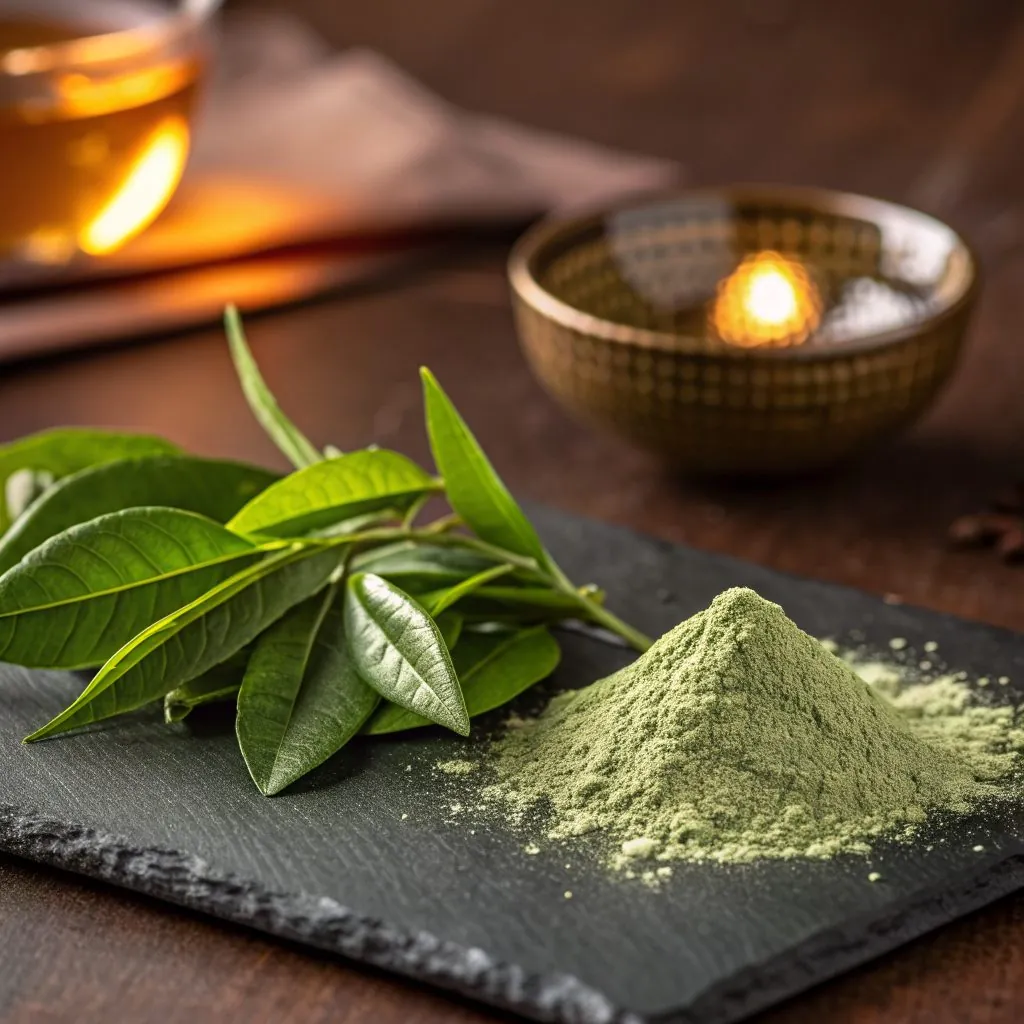
Green tea leaves beside L-theanine powderIn every 21 g sachet

What is L-theanine?

L-theanine is an amino acid that the body does not use to build proteins. Tea plants (Camellia sinensis) make it in their roots from glutamic acid and ethylamine and move it up to the young leaves, and it also occurs in several other plants of the same order, the Ericales.

The chemical name on the box, 'Y-Glutamylethylamide', is γ-glutamylethylamide, most likely printed with a Y standing in for the Greek letter γ (gamma). Researchers write the same molecule as γ-glutamyl-L-ethylamide.

Source for this section: Ashihara, Natural product communications, 2015, PMID 26058162.

Which tea has the most L-theanine?

A 2016 lab study measured L-theanine in commercial white, green, oolong, black and pu-erh teas, brewing 1 g of each in 100 ml of water at 80 °C for 3 minutes to mimic ordinary tea making. Green tea averaged the most, 6.56 mg per gram of tea, then white at 6.26, oolong at 6.09 and black at 5.13; no theanine was detected in the pu-erh.

The spread inside each type was wide, so the authors found theanine content no reliable way to tell one kind of tea from another. A 3-minute brew also leaves some behind: in their test on one green tea, a 90-minute extraction gave about twice as much L-theanine.

These are figures for tea leaves, not for Joe's Blend. The box does not say where its L-theanine comes from or how much a sachet holds.

Sources for this section: Boros and colleagues, Pharmacognosy magazine, 2016, PMID 27019564; the printed Joe's Blend box, batches 140525JCA3 and 140525JCA7.

L-theanine and caffeine: what have trials tested?

Researchers have tested L-theanine together with caffeine. One 2008 trial was randomised, placebo-controlled, double-blind and crossover: the same volunteers took L-theanine, caffeine, both together and a placebo in separate sessions, then did attention, memory and mood tests while their salivary caffeine was tracked.

That trial used fixed amounts of its own and did not test Joe's Blend, whose box prints no L-theanine amount. A result from one amount and form does not tell you what an unknown amount in a coffee mix does, so this page describes the design and leaves the results in the paper.

Sources for this section: Haskell and colleagues, Biological psychology, 2008, PMID 18006208; the printed Joe's Blend box, batches 140525JCA3 and 140525JCA7.

How much L-theanine is in a sachet?

The box does not print it. The order of the list gives a range, not a number: labels list ingredients heaviest first, and L-theanine is seventh, so by the label's order a sachet holds less of it than L-carnitine, which is sixth, and more than glutathione, which is eighth. That is an inference from the order, not a measurement. The Eurofins report covers nutrition, not added ingredients.

We will add a milligram figure only when the formulation sheet or a lab test states one.

Sources for this section: the printed Joe's Blend box, batches 140525JCA3 and 140525JCA7; Codex Alimentarius labelling standard CODEX STAN 1-1985, FAO and WHO; Eurofins nutrient report AR-25-E9-005753-01.

What does a 2025 review say about L-theanine claims?

A 2025 review of L-theanine's chemistry, metabolism and the biological activities claimed for it found the evidence behind many of its health claims limited, and concluded that the science does not yet match the hype around it as a supplement for brain health and relaxation.

That is why this page stops at what L-theanine is and where it sits on the label. Joe's Blend makes no claim that L-theanine changes how you think, feel or sleep.

Source for this section: Dashwood and colleagues, Nutrition research, 2025, PMID 39854799.

The research

What does the research on L-theanine cover?

One trial, two reviews and one tea analysis, each described by what it covered.

The effects of L-theanine, caffeine and their combination on cognition and mood.

Haskell CF, Kennedy DO, Milne AL. Biological psychology, 2008.

Randomised, placebo-controlled, double-blind crossover trial of L-theanine, caffeine and both together, with attention, memory and mood tests and salivary caffeine tracked. It did not test Joe's Blend.

PubMed 18006208 →

Theanine and Caffeine Content of Infusions Prepared from Commercial Tea Samples.

Boros K, Jedlinszki N, Csupor D. Pharmacognosy magazine, 2016.

Measured L-theanine and caffeine in commercial white, green, oolong, black and pu-erh teas brewed for 3 minutes at 80 °C. Green tea averaged the most L-theanine; none was detected in pu-erh.

PubMed 27019564 →

Occurrence, biosynthesis and metabolism of theanine (γ-glutamyl-L-ethylamide) in plants: a comprehensive review.

Ashihara H. Natural product communications, 2015.

Review of where theanine occurs in plants, how tea roots make it from glutamic acid and ethylamine, and how the leaves break it down.

PubMed 26058162 →

l-theanine: From tea leaf to trending supplement - does the science match the hype for brain health and relaxation?

Dashwood R, Visioli F. Nutrition research, 2025.

Review of L-theanine's chemistry, metabolism and the biological activities claimed for it. Finds the evidence for many health claims limited and calls for well-designed human trials.

PubMed 39854799 →

Education, not advice. Joe's Blend is coffee, not medicine, and carries no approved therapeutic claims. If you have a condition or take medication, talk to your doctor before adding anything new to your day.

Sources for this section: Haskell and colleagues, Biological psychology, 2008, PMID 18006208; Boros and colleagues, Pharmacognosy magazine, 2016, PMID 27019564; Ashihara, Natural product communications, 2015, PMID 26058162; Dashwood and colleagues, Nutrition research, 2025, PMID 39854799.

FAQ

L-theanine questions, answered without claims

What is L-theanine?

An amino acid that the body does not use to build proteins. It is the most abundant one of its kind in tea leaves, and tea plants make it in their roots.

What does 'Y-Glutamylethylamide' on the label mean?

It is the chemical name of L-theanine, γ-glutamylethylamide, most likely printed with a Y standing in for the Greek letter γ (gamma).

How much L-theanine is in Joe's Blend?

The box does not print it. L-theanine is seventh of nine ingredients, so by the label's order a sachet holds less of it than L-carnitine and more than glutathione. That is an inference from the order, not a measured amount.

Has L-theanine been studied with caffeine?

Yes. Placebo-controlled trials have tested L-theanine and caffeine together at their own fixed amounts. None tested Joe's Blend, and Joe's Blend makes no claim for L-theanine.

Which tea has the most L-theanine?

In a 2016 lab study of commercial teas brewed for 3 minutes, green tea averaged the most, 6.56 mg per gram of tea, then white, oolong and black; none was detected in pu-erh.

Is the L-theanine in Joe's Blend from tea?

The box does not say. It prints 'L-Theanine (Y-Glutamylethylamide)' with no source, so this page does not say where it comes from.

Sources

  1. Joe's Blend Coffee box: printed ingredient list, directions and storage line, batches 140525JCA3 and 140525JCA7 (manufactured 14 May 2025, expiry 14 May 2027). Read from photographs of two boxes, 16 September 2026. The list is reproduced on our facts page. joesblend.com/facts
  2. Ashihara H. Occurrence, biosynthesis and metabolism of theanine (γ-glutamyl-L-ethylamide) in plants: a comprehensive review. Natural product communications, 2015. PMID 26058162
  3. Boros K, Jedlinszki N, Csupor D. Theanine and Caffeine Content of Infusions Prepared from Commercial Tea Samples. Pharmacognosy magazine, 2016. PMID 27019564
  4. Haskell CF, Kennedy DO, Milne AL. The effects of L-theanine, caffeine and their combination on cognition and mood. Biological psychology, 2008. PMID 18006208
  5. Codex Alimentarius: General Standard for the Labelling of Prepackaged Foods, CODEX STAN 1-1985 (Rev. 1-1991), sections 4.2.1.2 to 4.2.1.4, the text hosted by FAO. FAO and WHO. Read 30 September 2026. fao.org
  6. Eurofins Analytical and Assurance Services Philippines, Quezon City: nutrient report AR-25-E9-005753-01 (964-2025-00005149) for Joe's Blend Coffee, results per 100 g and per 21 g serving, actual and rounded. The rounded values are on our facts page. joesblend.com/facts
  7. Dashwood R, Visioli F. l-theanine: From tea leaf to trending supplement - does the science match the hype for brain health and relaxation? Nutrition research, 2025. PMID 39854799
One box of Joe's Blend Coffee, 10 sachets
Try it in the cup

One box. Ten mornings.

Arabica with L-theanine, L-glutathione and L-carnitine, in a 21 g sachet. Hot or iced, 30 seconds.

₱54910 sachets · ₱54.90 a cup · shipping included
Explore

The other ingredients